Shorter charging stops
The 20–80 kW family serves sites where drivers have less time to park.

DC charging
20 to 80 kW configurations for light fleets, dealerships, commercial parking and service locations.
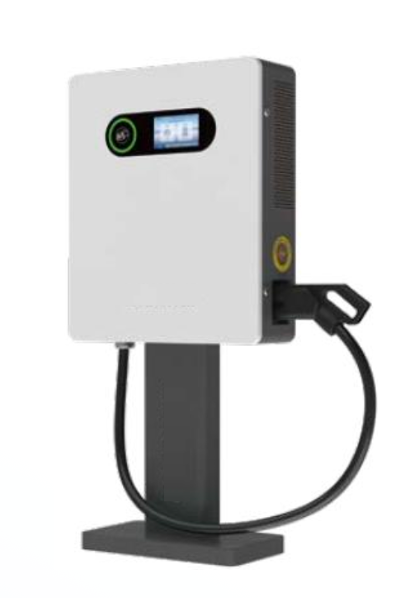
PRODUCT IN CONTEXT
Urban DC charging is selected by required energy, vehicle charging curve and the acceptable wait at the site.
Estimate demand per hour and queue tolerance.
Match voltage, power curve and concurrent sessions.
Measure uptime and next-session readiness.
PRODUCT FACTS
Compare the numbers that affect vehicle fit, site design and operations.
| Parameter | Portfolio reference |
|---|---|
| Rated power | 20 / 30 / 40 kW · 60 / 80 kW |
| DC output voltage | DC 200–1000 V |
| AC input | AC 400 V ±10%, 3P+N+PE |
| Connector options | CCS2 / GB/T |
| Output current by model | 20–40 kW: 66 / 100 / 125 A; 60–80 kW: 200 / 250 A |
| Efficiency | ≥95% at ≥50% load |
| Protection | IP55 / IK10 |
| Communication | OCPP 1.6J; OCPP 2.0 optional |
Reference portfolio values. Exact model, connector, market certification and optional features must be confirmed in the project quotation. Rated power is not a per-connector simultaneous output guarantee.
WHY THIS FAMILY
The 20–80 kW family serves sites where drivers have less time to park.
Choose a compact unit or dual-output configuration for the parking layout.
Bring charger status, sessions and alerts into site operations.
Plan deployment around vehicle demand and available site power.
CONFIGURATION OPTIONS
Actual charging power varies through a session. Vehicle limits and battery conditions must be considered in time estimates.
| Application | Configuration | Selection rationale |
|---|---|---|
| Dealership, workshop or service bay | 20–30 kW DC | Adds useful energy without requiring high-power site infrastructure. |
| Retail and destination top-up | 30–40 kW DC | Matches medium dwell and moderate session energy. |
| Urban commercial fleet | 40–60 kW DC | Supports operational turnaround for light and medium vehicles. |
| Higher-turnover public or fleet site | 60–80 kW dual-output configuration | Can serve more sessions with managed allocation. |
INSTALLATION & VALIDATION
Arrival state, energy target, available minutes and daily sessions.
Connector, voltage, current, protocol and charge curve.
Base load, peak demand, protection and simultaneous outputs.
Bay position, cable reach, accessibility, signage and queue.
Vehicle tests, communications, sustained sessions and alarms.
YOUR QUESTIONS, ANSWERED
Practical answers about DC fast charging. No guesswork.
Ask about your project10 questions
No. The vehicle, voltage, battery temperature, state of charge and power-sharing configuration determine actual power.
We estimate time from the energy target and vehicle charge curve. Power normally changes during the session.
When session volume, vehicle mix or availability justifies serving two bays, subject to simultaneous-power behavior.
Yes when the design includes an appropriate site limit and coordination with other loads.
Inspection, cleaning, connector and cable checks, cooling review, firmware management, alarm analysis and corrective service according to the selected model.
Potentially through OCPP or APIs, after validating the exact charger, platform, data fields and operational workflow.
Not without review. Supply capacity, cabling, protection, foundations and service clearances may differ, so the site needs a fresh installation assessment.
Not necessarily. Separate equipment, management software, payment integration and local settlement costs so the purchasing scope is clear.
Test single-vehicle output, simultaneous power sharing, authorization, session records, emergency stop and communication recovery using representative vehicles.
Provide country, vehicle models, connector needs, target power, quantity and backend requirements. Confirm the selected data sheet and supply boundaries before ordering.
No matching question. Try another word or contact our team.
YOUR NEXT PROJECT
Your vehicles. Your site. Your operating goals. Start a conversation around the system you actually need.